Seasonal Care
Spring Coat Blow: Helping Your Double-Coated Dog Through Shedding Season
What is happening when your double-coated dog suddenly sheds in clumps, how to brush the undercoat out properly at home, and why shaving is not the answer.
Nat · March 9, 2026 · 5 min read
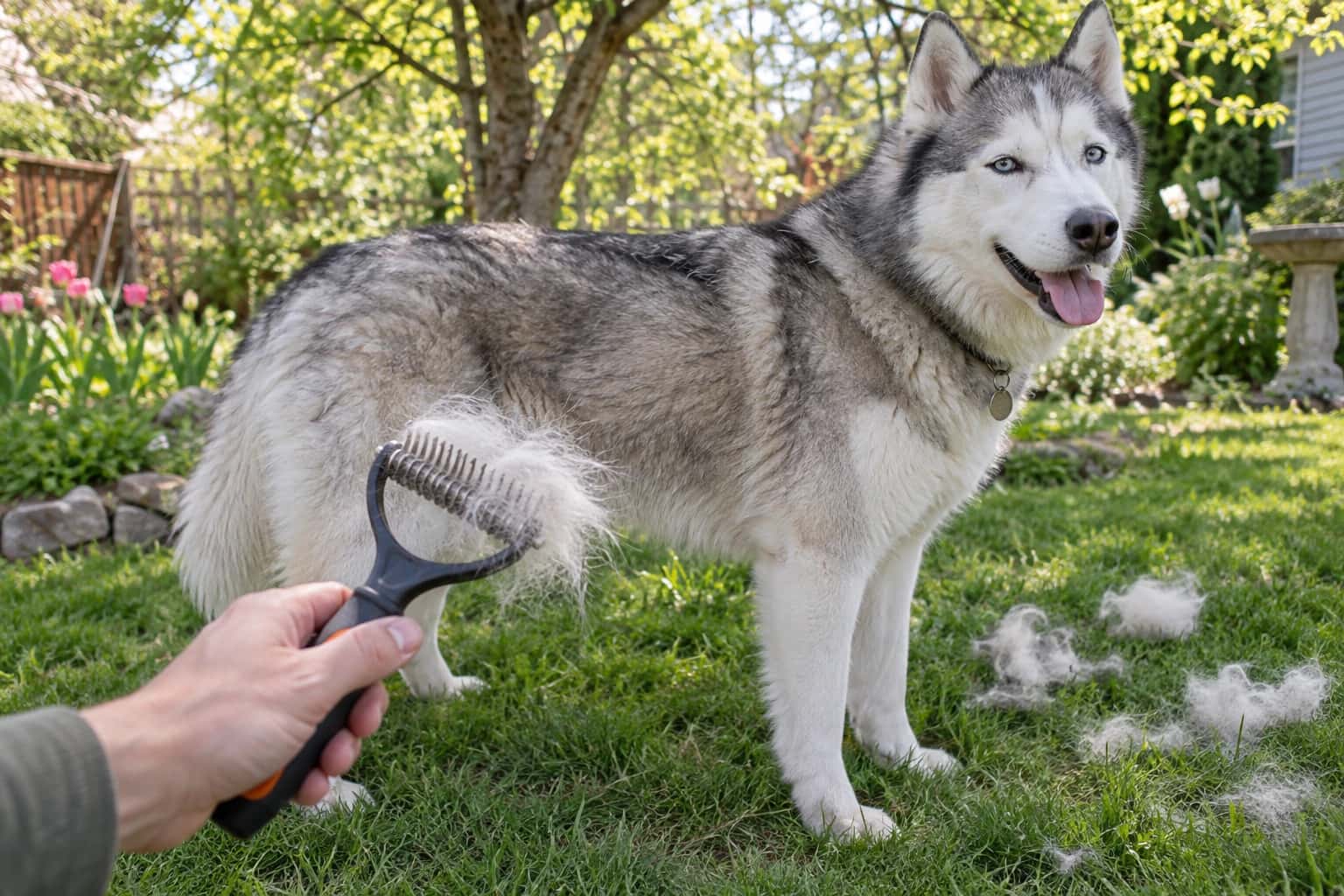
Every spring some owners get a fright. Their Husky, Shepherd, Golden, or Corgi is suddenly pulling out in handfuls, the vacuum is full by Tuesday, and they want to know if something is wrong. Almost always, nothing is. Their dog is blowing coat, and it is one of the most normal things a double-coated dog does all year.
What is actually happening
A double coat has two layers. The outer guard hairs are longer and coarser and protect the skin from weather and sun. Underneath is the undercoat, a dense, soft layer that holds warmth close to the body.
As the days get longer and warmer, the body lets go of the thick winter undercoat. Instead of shedding a little at a time, a lot of it loosens over a few weeks. That is the "blow." Our mild East Bay winters mean some dogs shed more steadily through the year, but most double-coated dogs still have a noticeable heavy shed in spring.
The trouble is that loose undercoat does not always fall out on its own. It gets caught in the guard hairs and packs down against the skin, especially behind the ears, on the back of the thighs (the "pants"), around the neck, and at the base of the tail. Packed undercoat traps heat and moisture against the skin, which is the opposite of what your dog needs heading into summer.
Brushing it out at home
The goal is to get the loose undercoat out, gently and all the way down to the skin. Three tools make that much easier.
An undercoat rake. One or two rows of long, rounded teeth that reach through the guard hairs and lift out loose undercoat. Use it in the direction the hair grows, with light pressure, and let the teeth do the work.
A slicker brush. Fine wire bristles for working through lighter areas and finishing. Be gentle. Pressing hard, or going over the same spot again and again, can scrape the skin and cause brush burn.
A metal comb. This is how you check your work. If the comb glides from skin to tip, that section is done. If it catches, there is still packed undercoat underneath.
Line brushing
Brushing the top of the coat can make a dog look tidy while the undercoat stays packed below. Line brushing fixes that.
- Start at a back leg or the base of the tail.
- With one hand, hold the coat up so you can see a thin line of skin.
- Brush the hair below that line from the skin outward.
- Let a little more hair down, making a new line just above, and repeat.
- Work up the body in rows, a section at a time.
It is slow, but it gets you to the skin, where the problem sits. Twenty calm minutes a day is kinder than a two-hour battle on a Sunday.
If you find a true mat, work it apart slowly from the edges with your fingers and the comb. Do not cut mats out with scissors. Skin tents up into them, and it is very easy to cut your dog. That is a job for a groomer.
How a deshedding bath and blow-out helps
During a heavy blow, the most effective thing I do is a deshedding bath followed by a thorough blow-out.
Warm water and a good soak help loosen undercoat that is ready to come out, and conditioner helps it slide free instead of snagging. Then a high-velocity dryer pushes air down through the coat to the skin, and you can watch the loose undercoat lift out in clouds. It works by moving air rather than heat, so it clears out what brushing alone tends to leave behind.
After the blow-out I go back over the coat with a rake and comb to catch what is left. Most dogs come out noticeably lighter and softer, and owners usually see much less hair on the floor for a while after.
What about shaving?
Shaving a double coat usually backfires: it takes away the coat's insulation and sun protection, and the coat can grow back patchy. For shedding, a proper deshed does more good.
Signs it is more than a normal shed
A coat blow should leave a full, healthy coat behind. Check in with your vet if you notice:
- Bald patches, or thinning that does not grow back
- Red, scaly, or broken skin
- Constant scratching, licking, or chewing
- Shedding that goes on for months without easing
- A dull, brittle coat along with changes in energy or weight
Getting through the season
A spring coat blow is a few messy weeks, not a problem to fix. Keep up with gentle line brushing, keep a lint roller by the door, and remember that your dog is simply getting ready for summer. If the undercoat is getting ahead of you, a deshedding bath and blow-out can take care of most of it in one visit.